Why Your Billion-Dollar Family Office Still Runs on Spreadsheets
I've spent nearly three decades watching ultra-high-net-worth families struggle with a problem that shouldn't exist.
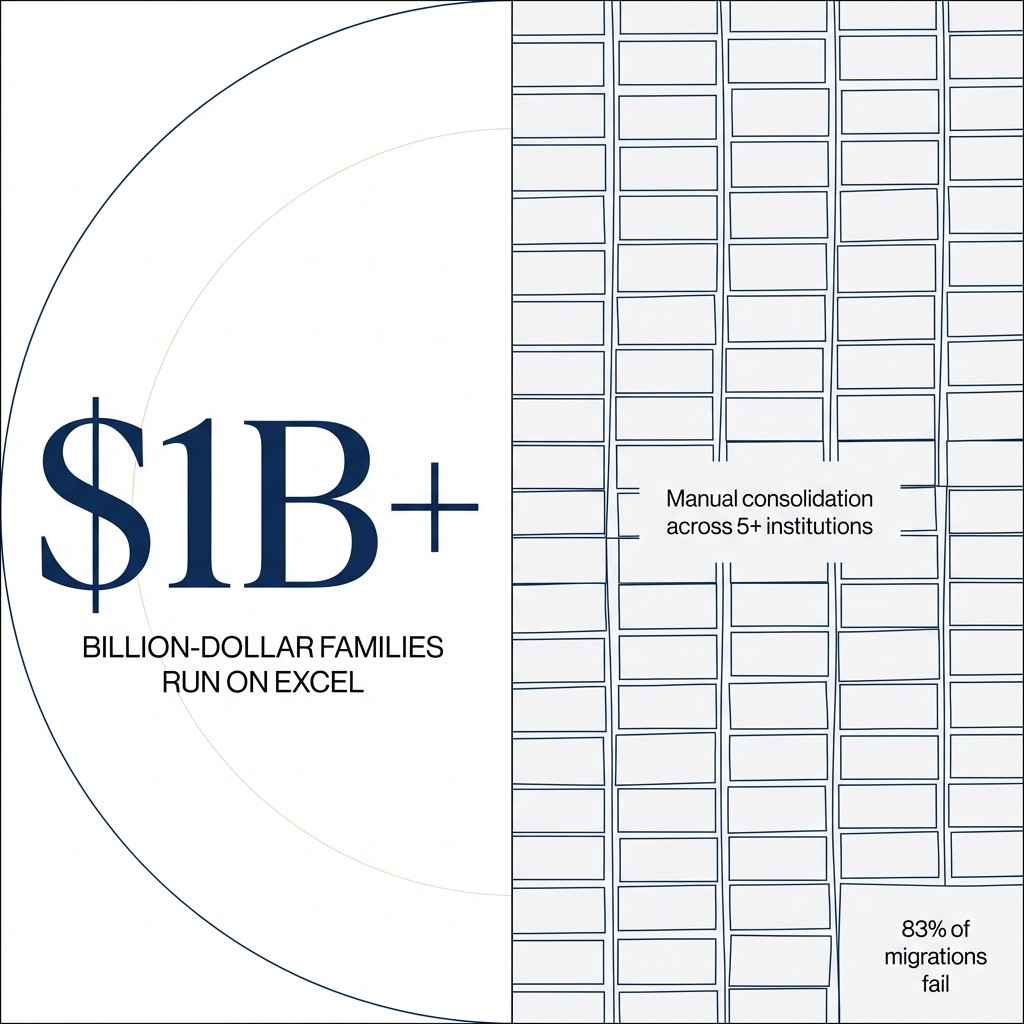
Families managing over a billion dollars in assets still consolidate their net worth in Excel.
This isn't a technology problem. The software exists. I've seen every platform on the market, implemented dozens of systems, and helped families migrate from one solution to another more times than I can count.
The real issue is that families don't own their data.
The Control Problem Nobody Talks About
When I ran a multifamily office for 20 years, I saw the same pattern repeat. A family would work with us for years, building up historical performance data, tax records, and entity structures in our systems. Then something would change—maybe they weren't happy with investment performance, or they wanted to work with a specialist we didn't have in-house.
They faced an all-or-nothing decision.
Leave and lose everything—all that historical data, all that institutional knowledge, all those carefully built reporting structures. Or stay and accept subpar service in one area because the switching cost felt too high.
That's when I realized the fundamental problem. Families don't control their own financial information. Their advisors do.
I started CFO Family in 2021 to solve this. Not by building another software platform, but by helping families take ownership of their data infrastructure. When you control your reporting systems, you can hire and fire advisors without losing continuity. You can select best-in-class specialists for different functions instead of accepting bundled services from a single provider.
This is how large single family offices operate. They have their own CFO, their own back office, their own systems. Everyone else—investment advisors, tax planners, attorneys—works for them, not the other way around.
The Two-System Reality
Here's something most families don't understand until they're deep into implementation.
You need two completely different systems to see your full financial picture.
Performance reporting systems track investment returns, market movements, and portfolio analytics. They tell you how your investments are performing relative to benchmarks, what your asset allocation looks like, and which positions are up or down.
Accounting systems track cash flows, tax implications, and entity-level transactions. They tell you where money is actually moving, what you owe in taxes, and how different legal entities interact.
The same investment property generates different data in each system. Your performance system shows the property appreciated 8% this year. Your accounting system shows you paid $50,000 in property taxes, received $120,000 in rental income, and made a $200,000 capital improvement.
Both views are correct. Both are incomplete on their own.
Most families try to force one system to do both jobs. Or they manually reconcile disparate systems through spreadsheets. According to recent research, the average family office works with more than five financial institutions, which means manual consolidation work, inconsistent numbers, and slow reporting.
This is why family offices most frequently cite manual processes and overreliance on spreadsheets as operational risks.
The Question Families Can't Answer
I ask every new client the same question: Where is your cash right now?
You'd be surprised how often families with billion-dollar portfolios can't give me a confident answer.
They know their net worth. They know their asset allocation. They can tell you their top-performing investments by IRR. But when I ask about liquidity—where cash is located, how much is available, what future capital calls are coming, whether current reserves can meet commitments—the conversation gets vague.
This gap becomes more pronounced as families shift into private investments and alternative assets. Alternative assets now make up 42% of family office portfolios, according to BlackRock's 2025 survey, up from 39% previously. More than half of family offices are bullish on private credit and infrastructure.
These investments create complex cash flow patterns. Capital calls don't arrive on predictable schedules. Distributions happen when exits close, not when you need liquidity. Your "diversified portfolio" is actually nested layers of illiquidity, each with different lockup periods and redemption windows.
Understanding this requires systems that talk to each other. Your performance system needs to feed data to your accounting system. Your accounting system needs to project forward based on committed capital. Your cash management system needs to aggregate across multiple entities and custodians.
Most families don't have this integration. They have disconnected systems that each tell part of the story.
The Migration Mistake
The biggest mistake families make when changing systems is underestimating migration complexity.
I've seen families rush into new platforms because they're frustrated with current limitations. They sign contracts, start implementation, and then discover their historical data doesn't map cleanly to the new system's structure.
Different platforms track different attributes. They organize information according to varying logic. Moving from an accounting-centric system to a performance-focused platform means confronting the reality that more data exists than the new system may accommodate.
Research shows that 83% of data migration projects either fail or exceed their budgets and schedules.
This isn't a vendor problem. It's a structural reality of how financial data works.
When we help families migrate systems, we spend months on data cleaning before we touch the new platform. We map existing data structures to new requirements. We identify gaps where historical information won't transfer. We build processes to maintain both systems in parallel during transition.
This takes time. Families who skip this work end up spending months fixing incorrect reports and rebuilding lost context.
What AI Actually Does Right Now
Everyone wants to talk about AI in family office reporting. I get asked about it constantly.
Here's what AI can do today: answer standard analytical questions faster than you can navigate dashboards manually.
Which investments have the highest IRR? How has allocation shifted over the past year? Show me custom visualizations of performance by asset class. AI agents can pull this information and present it conversationally.
But AI deployed on unclean data delivers incorrect answers faster than humans would. Not necessarily worse answers. Just faster incorrect ones.
The critical prerequisite for AI implementation is data cleanliness. You need AI-assisted data cleaning agents before you deploy AI-assisted analytical agents. This is why 69% of family offices have now adopted automated investment reporting systems, up from 46% last year.
Trust has become the defining metric. The bottleneck isn't data collection anymore. It's reconciliation and confidence in what the systems produce.
The Next 24 Months
The evolution I'm watching closely involves AI systems that synthesize answers across multiple disconnected platforms.
When a family asks why net worth decreased, the performance system provides one answer based on market movements and asset revaluations. The accounting system provides a different answer based on cash outflows exceeding inflows.
Both are partially correct. Neither tells the complete story.
Next-generation AI systems will query multiple platforms simultaneously, synthesize holistic answers, and identify contributing factors across performance, accounting, compliance, and operational systems.
This requires families to control their data infrastructure. You can't build cross-platform AI integration when different advisors control different pieces of your financial information.
Why No Single Solution Works
I don't sell software. This is intentional.
No single software stack fits all family offices, even those of similar size or generational structure. A family with predominantly public market investments has fundamentally different operational needs than a family heavily weighted toward private equity, real estate, and alternative investments.
Rigid technology prescriptions that work for one profile create friction for another.
When families come to us, we start by understanding their specific situation. How many entities do you have? What's your public-private split? How many advisors do you work with? What decisions do you need to make, and what information do those decisions require?
Then we recommend systems based on functional requirements, not vendor relationships. Sometimes the best intervention isn't new software at all. It's better utilization of existing systems combined with automated data flow processes.
Many families possess functional technology stacks but lack the processes to use them effectively or the automation to reduce manual reconciliation work. Bot-driven automation and workflow optimization often delivers more value than system replacement.
The Governance Connection
Family governance becomes substantially easier when you control your own data.
Articulating values, legacy intentions, investment policy, and multi-generational objectives requires information. When that information is scattered across multiple advisors and systems, assembling it feels overwhelming. Families avoid governance work not because they don't value it, but because getting started requires coordinating multiple external parties.
Data sovereignty reduces this friction.
When you can selectively share information with advisors, family members, and service providers from systems you control, governance planning becomes a manageable project instead of an intimidating coordination nightmare.
This matters more as wealth transfers accelerate. Research shows that almost 50% of family offices expect generational wealth transfer to happen within 10 years.
Organized, accessible systems that connect investment policy statements to performance monitoring, tie back to family governance documents, and integrate with tax and legal planning create clarity for rising generations.
Rather than inheriting loosely organized assets with scattered information and unclear intent, next-generation members can understand the purpose, direction, and structure of family wealth within coherent systems.
What Independence Actually Means
CFO Family doesn't manage investments. We don't provide tax advice. We don't practice law.
This independence is the entire point.
When your reporting infrastructure is independent from your advisors, you can maintain excellent relationships while replacing underperforming ones. You can work with specialists who are best-in-class for specific functions instead of accepting bundled services because switching feels impossible.
We offer three levels of engagement. Some families just need independent consulting on systems and processes. Others need implementation help and process creation. Some want to fully outsource back-office operations.
The common thread is that families control the outcome. They own the data. They make the decisions. We provide the operational infrastructure and expertise to make that control practical instead of theoretical.
This is how wealth persists across generations. Not through perfect investment returns or sophisticated tax strategies, though those matter. Through institutional knowledge, clear governance, and systems that outlast individual advisor relationships.
Your billion-dollar family office runs on spreadsheets because the alternative has been giving up control to access better systems.
That trade-off isn't necessary anymore.


Comments
Post a Comment